
If you have been accused of receiving stolen property in New York, the charge on your paperwork will usually have a different name:criminal possession of stolen property.
These cases can be highly fact-specific. It is not enough for prosecutors to show that property turned out to be stolen or that it was found near you. They must prove that you possessed stolen propertyknowing that it was stolen, together with the intent required by New York law.
That knowledge requirement is often one of the most important issues in the defense.
What Is “Receiving Stolen Property” Called in New York?
New York does not have a crime formally titled “receiving stolen property.” Instead, Penal Law Article 165 criminalizescriminal possession of stolen property.
Under Penal Law § 165.40, a person commits the basic offense when the person knowingly possesses stolen property with the intent to benefit themselves or someone other than the owner, or to impede the owner’s recovery of the property.
The law is broader than simply “receiving” stolen goods from another person. You can be accused of possessing property you purchased, accepted, carried, stored, concealed, or otherwise controlled.
And there is an important point many people do not realize:it is not a defense that the defendant was not the person who stole the property.Nor is it a defense that the original thief was never identified, arrested, or convicted.
What Must Prosecutors Prove?
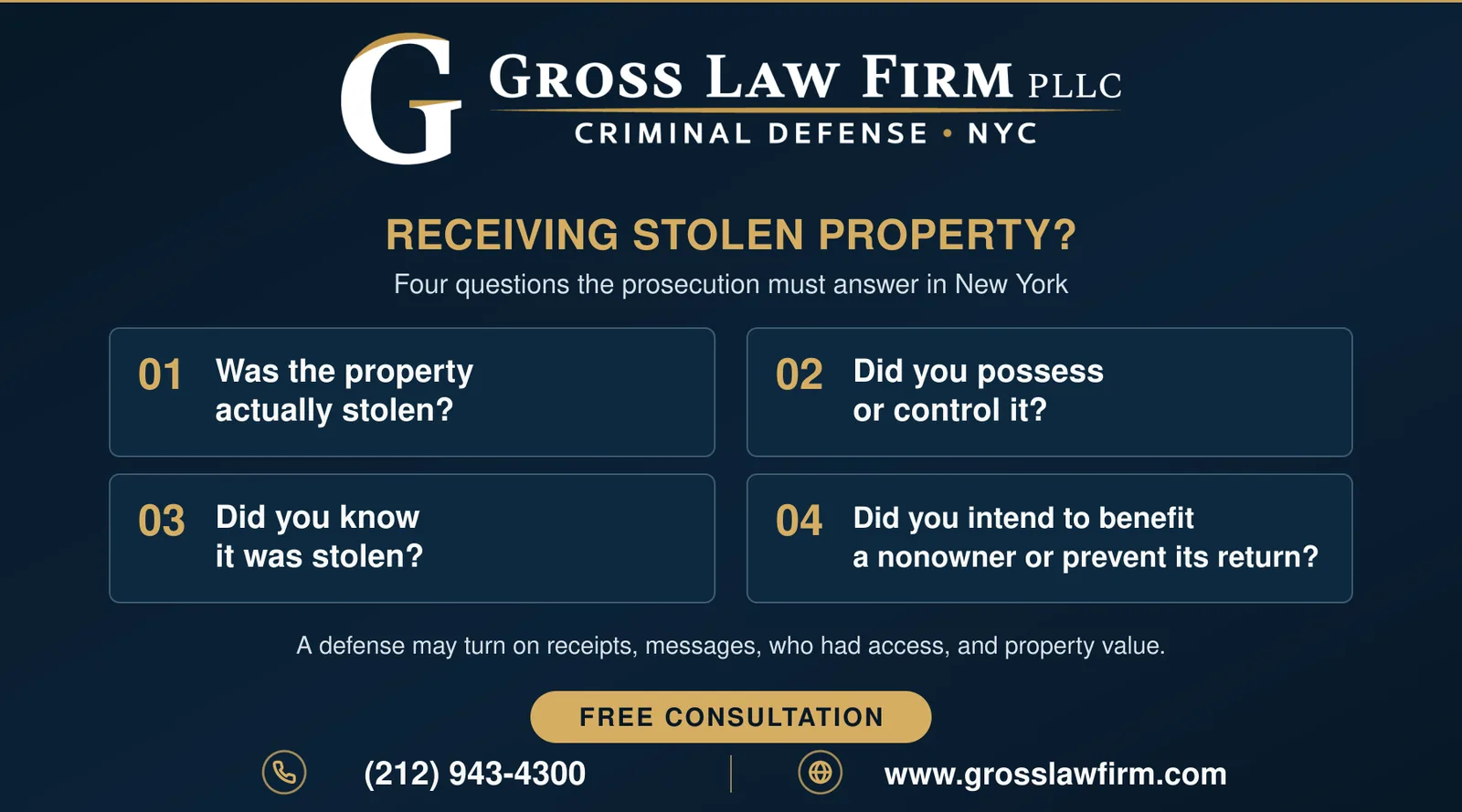
Although the precise elements depend on the degree charged, a criminal possession of stolen property case generally revolves around four questions:
Was the property actually stolen?The prosecution must establish that the property was wrongfully taken, obtained, or withheld from an owner.
Did you possess it?Possession can be physical or constructive.
Did you know it was stolen?This is frequently the central issue.
Did you have the required intent?The prosecution must prove an intent to benefit yourself or someone other than the owner, or to prevent or interfere with the owner’s recovery of the property.
Failure of proof on one of the above required elements means the prosecution has not established each element of the crime beyond a reasonable doubt.
What Does “Possession” Mean?
Possession does not require that stolen property be found in your hands or pockets.
New York recognizesconstructive possession, meaning prosecutors may attempt to prove possession by showing that a defendant exercised sufficient dominion or control over the property or over the area where the property was found.
But location alone does not automatically establish possession. If stolen property was found in a shared apartment, a vehicle occupied by several people, a common storage area, or another location accessible to others, the prosecution still must prove the defendant’s dominion or control. That can create a significant factual issue for the defense.
How Does the Prosecution Prove You Knew Property Was Stolen?
The prosecution does not need a confession such as, “I knew it was stolen.”
Knowledge can be established through circumstantial evidence. New York courts have recognized that a prosecutor may rely on circumstances such as a defendant’s conduct, contradictory explanations, or possession under circumstances from which guilty knowledge may reasonably be inferred.
That does not mean suspicious circumstances automatically establish guilt.
The defense should examine how the property was acquired, what was paid for it, what the defendant was told, whether there was a receipt or bill of sale, communications between the parties, whether serial numbers or identifying information had been altered, what the defendant did after acquiring the property, and what statements were allegedly made to police.
The real question is whether the evidence provesknowledge, not merely whether, in hindsight, the transaction should have raised questions.
Criminal Possession of Stolen Property: Degrees and Penalties
The degree is often based on value, although Penal Law § 165.45 contains several circumstances that make possession a felony regardless of the ordinary $1,000 threshold.
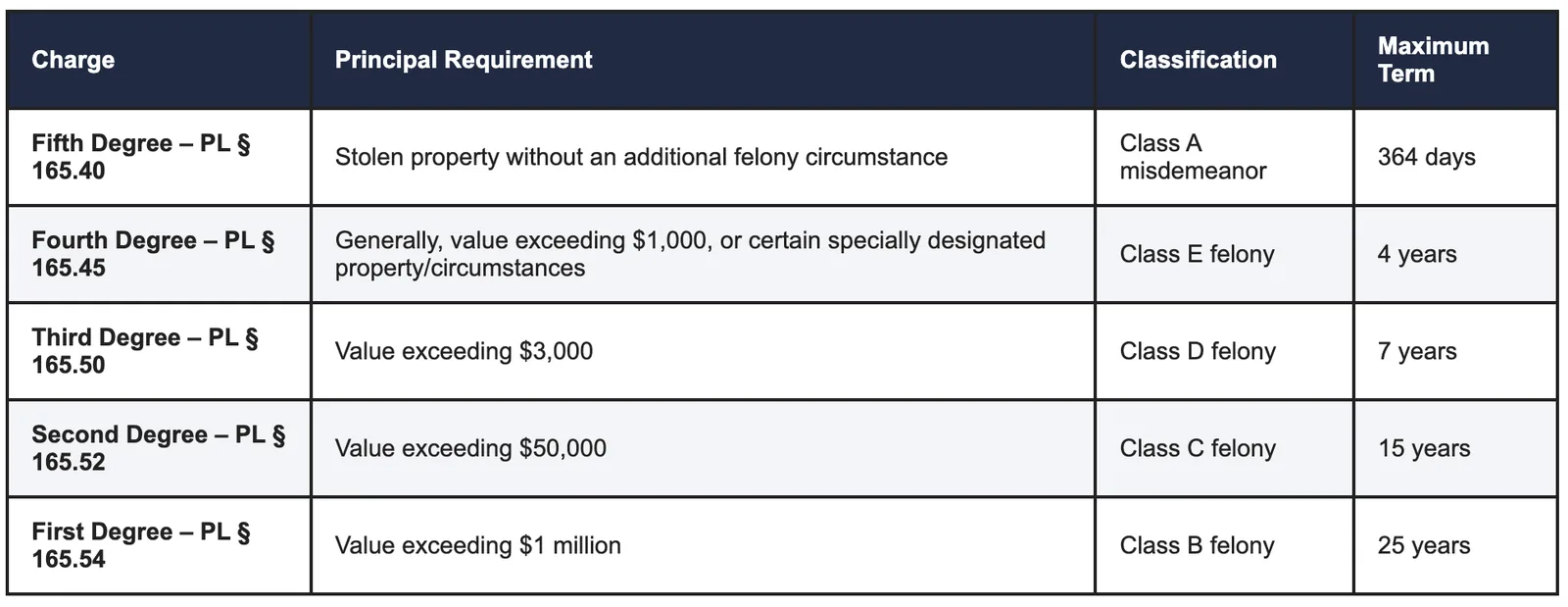
Fourth-degree criminal possession (a Class E felony) can also apply to property such as a stolen credit, debit, or public benefit card; firearms, rifles, or shotguns; a motor vehicle worth more than $100 other than a motorcycle; certain religious property worth at least $100; and specified other circumstances listed in Penal Law § 165.45. The statute also contains a separate provision covering collateral loan brokers and people in the business of buying, selling, or otherwise dealing in property.
These aremaximum sentences, not automatic sentences. Sentencing depends on the charge, the defendant’s prior record, the circumstances of the offense, and other factors. Probation and other non-incarceratory dispositions may be available in appropriate cases.
What Is the Legal Value of Allegedly Stolen Property?
Value can make the difference between a misdemeanor and a felony—or between different felony degrees.
New York generally uses the property’smarket value at the time and place of the crime. If market value cannot satisfactorily be determined, the statute provides other methods of valuation.
That means an original retail price, asking price, or replacement price does not necessarily establish the value the prosecution must prove.
For used vehicles, electronics, jewelry, tools, luxury merchandise, and other depreciating property, a valuation challenge can substantially change the seriousness of the case.
Presumptions in Stolen Property Cases
New York law contains several statutory presumptions that can become important.
A person who knowingly possesses stolen property may be presumed to possess it with the required intent to benefit someone other than the owner or impede the owner’s recovery. A dealer in property who obtains stolen goods without making the inquiry required by the statute may face a presumption of knowledge. Possession of two or more stolen credit, debit, or public benefit cards can also create a presumption that the possessor knew they were stolen.
These presumptions do not eliminate the prosecution’s burden of proving guilt beyond a reasonable doubt. For example, New York’s model jury instruction explains that the jurymay, but is not required to, draw the intent inference from knowing possession.
Defenses to Criminal Possession of Stolen Property
Depending on the evidence, defenses may include:
- No knowledge the property was stolen.A legitimate purchase, ordinary transaction, receipt, bill of sale, text messages, online listing, or other evidence may undermine the claim that the defendant knew the property’s true origin.
- No actual or constructive possession.Mere proximity to stolen property does not establish dominion or control.
- The property was not stolen.An ownership dispute, loan, permission to use the property, or another legitimate explanation may defeat an essential element.
- Insufficient proof of value.The prosecution must establish the value necessary for the particular felony degree.
- No intent to benefit or impede recovery.The surrounding circumstances may contradict the required criminal intent.
- The statutory presumption has been rebutted.Evidence explaining possession can undermine an inference prosecutors ask the factfinder to draw.
- Illegal search or seizure.Evidence obtained in violation of constitutional protections may be subject to suppression.
- Improperly obtained statements.Statements resulting from custodial interrogation without required Miranda warnings, or statements that were involuntary, may be challenged.
- Insufficient accusatory instrument or proof.Particularly in misdemeanor cases, the prosecution must allege and ultimately prove facts supporting not merely unauthorized possession but that the property was stolen and that the defendant knew it was stolen.
A recent New York City decision illustrates the last point. InPeople v. Hartman, 89 Misc. 3d 1224(A), 2026 N.Y. Slip Op. 51049(U) (Crim. Ct., N.Y. County, June 17, 2026), the court emphasized that the prosecution could not simply rely on the fact that a vehicle was possessed without the owner’s permission to establish the separate requirement that the defendant knew it was stolen.
What Evidence Can Help the Defense?
The best defense may begin with evidence that existedbefore anyone called the police.
A legitimate online listing, text exchange with the seller, payment record, receipt, vehicle paperwork, repair records, photographs, marketplace messages, or witnesses to the transaction can provide contemporaneous evidence explaining how the defendant obtained the property and what the defendant believed at the time.
That evidence can be particularly important because prosecutors often try to prove knowledge circumstantially.
Preserving those records early can therefore matter.
How Are Stolen Property Cases Resolved in New York City?
Not every criminal possession of stolen property case goes to trial.
For qualifying lower-level arrests, New York’s appearance-ticket statute generally provides for release with a future court date, subject to statutory exceptions. An appearance ticket doesnotmean the charge is insignificant; it simply changes the procedure for getting the defendant into court.
In appropriate misdemeanor cases, anadjournment in contemplation of dismissal (ACD)may also be negotiated. Under CPL § 170.55, an ordinary ACD generally results in dismissal after six months if the case is not restored to the calendar. It requires the consent specified by the statute and is not automatically available simply because someone has no prior record.
Other cases may resolve through dismissal, reduction of a felony to a misdemeanor, a plea to another offense, or trial.
New York’s discovery statute also requires automatic disclosure of substantial categories of prosecution evidence. Reviewing police reports, body-camera footage, defendant statements, property records, photographs, valuation evidence, and witness information can expose weaknesses that are not apparent from the initial accusation.
Immigration and Other Consequences
For a noncitizen, criminal possession of stolen property can create serious immigration consequences.
The Second Circuit has held that criminal possession of stolen property under Penal Law § 165.40 is a crime involving moral turpitude.Michel v. INS, 206 F.3d 253, 263 (2d Cir. 2000);Ottey v. Barr, 965 F.3d 84, 95 (2d Cir. 2020) (reaffirmingMicheland holding that third-degree criminal possession of stolen property is likewise a “crime involving moral turpitude” because it carries the same mens rea as PL § 165.40). Federal immigration law also expressly includes a “theft offense (including receipt of stolen property)” within the aggravated-felony definition when the applicable imprisonment requirement is satisfied. Immigration consequences depend on the precise conviction, sentence, immigration status, and record, so criminal and immigration counsel should coordinate before any plea is entered.
A conviction may also affect employment, professional licensing, housing, and other areas long after the criminal case ends.
Speak With a New York City Stolen Property Defense Lawyer
Criminal possession of stolen property cases frequently turn on facts that are easy to overlook:where the property was found, who controlled that location, how the property was acquired, what the defendant knew, what the property was actually worth, and what the defendant said or did before and after the arrest.
Those details can determine whether the evidence proves a felony, a misdemeanor, or any crime at all.
If you have been accused of receiving or possessing stolen property in Manhattan, Brooklyn, Queens, the Bronx, or Staten Island, speak with an experienced New York City criminal defense attorney before making a statement to detectives or prosecutors. Early review of the evidence can help preserve defenses, challenge unsupported assumptions, and determine the strongest strategy before important decisions are made.
Facing a theft charge? See how Gross Law Firm defends these cases or call (212) 943-4300 for a free consultation.
This article is general information, not legal advice for your situation. Reading it does not create an attorney-client relationship.