
There is no separate New York crime called “theft by false pretenses” or “theft by deception.” Instead, New York treats obtaining property through certain intentional misrepresentations aslarcenyunder Penal Law Article 155. Depending on the value and type of property involved, the charge may range from petit larceny, a misdemeanor, to grand larceny, a felony carrying substantial prison exposure.
The important question is not simply whether someone made a statement that turned out to be false. In a false-pretenses case, prosecutors must prove the particular type of misrepresentation, the defendant’s knowledge and intent, and that the owner actually relied on the representation in transferring the property.
What Is Larceny by False Pretenses in New York?
Under Penal Law § 155.05, a person commits larceny when, with the intent to deprive another of property or appropriate it to themselves or a third person, the person wrongfully takes, obtains, or withholds property from its owner.
Larceny by false pretensesis one way prosecutors may attempt to prove that wrongful taking. It generally requires proof that the defendant knowingly made a false representation about apast or existing factand obtained the property because the owner relied on that representation.
The distinction between a present fact and a future promise matters. For example, knowingly selling a counterfeit watch while representing that it is authentic may support a false-pretenses theory. A promise that something will happen in the future ordinarily raises a different theory, larceny by false promise.
False Pretenses vs. False Promise
False pretenses concerns a false representation about something that already happened or presently exists. False promise concerns a representation about future conduct.
Under Penal Law § 155.05(2)(d), larceny by false promise may occur when someone obtains property as part of a scheme to defraud by promising future conduct while intending, at the time of the promise, not to perform it.
A broken promise alone is not enough. New York imposes an unusually demanding evidentiary requirement. The prosecution must establish circumstances that are wholly consistent with guilty intent, wholly inconsistent with innocent intent, and exclude to a “moral certainty” every hypothesis other than that the defendant did not intend the promise to be performed.
That distinction can be critical in contractor disputes, failed investments, business transactions, and other cases where an unsuccessful deal is later characterized as criminal fraud.
When Does False Pretenses Become Grand Larceny?
When the degree of larceny is determined solely by the value of the property, New York’s principal thresholds are:
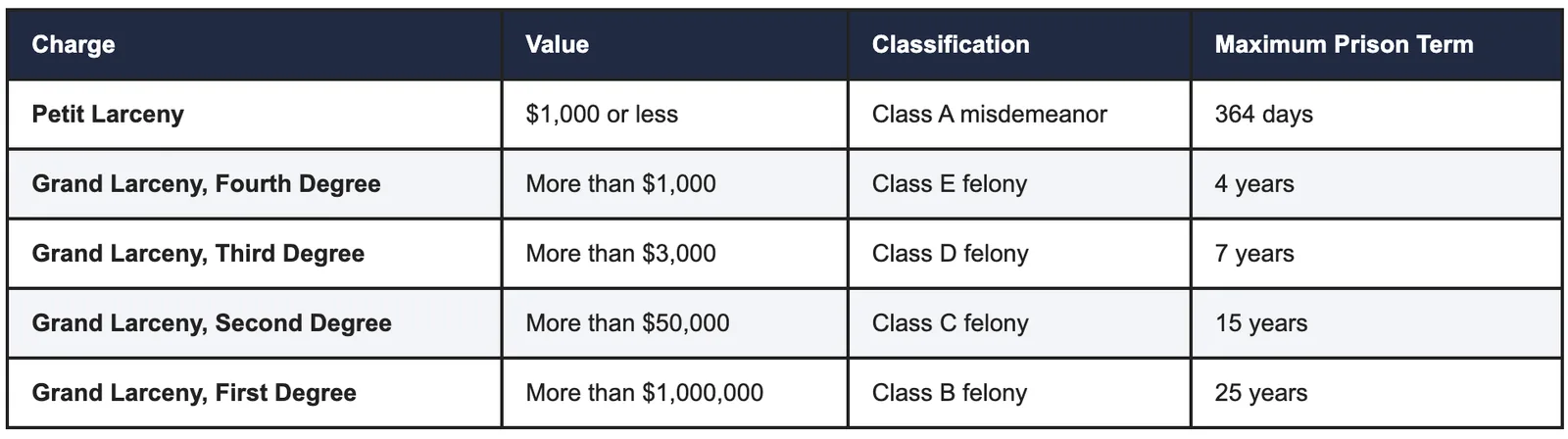
These are maximum sentences, not automatic sentences. A defendant’s criminal history and the particular circumstances of the case can substantially affect sentencing.
Value is also not the only way larceny becomes a felony. New York designates certain property and circumstances as grand larceny regardless of ordinary value thresholds. For example, stealing a credit or debit card or taking property directly from another person’s body may constitute grand larceny in the fourth degree regardless of value.
Related Fraud Charges
A false-pretenses investigation may produce charges beyond larceny. Depending on the allegations, prosecutors may also considerscheme to defraud, forgery, criminal possession of a forged instrument, identity theft, falsifying business records, insurance fraud, or other fraud-related offenses.
Scheme to defraud is particularly important in cases involving an alleged ongoing pattern directed at multiple people. Unlike a single larceny transaction, the statute focuses on a systematic and ongoing course of fraudulent conduct.
Some conduct can also attract federal scrutiny. Depending on the facts and the required federal nexus, prosecutors may investigate mail fraud under 18 U.S.C. § 1341 or wire fraud under 18 U.S.C. § 1343. Ordinary violations of those statutes carry maximum prison terms of 20 years.
Examples of False Pretenses and False Promise
The distinction between these theories is easier to understand through examples.
False pretenses may include knowingly claiming that merchandise is authentic when it is counterfeit, falsely claiming present ownership or authority to rent property, submitting an invoice stating that work has already been completed when it has not, or misrepresenting an existing credential or qualification to induce payment.
False promise cases are different. They may involve allegations that a contractor accepted a deposit while never intending to perform the promised work, or that money was obtained through a promise of future conduct that the prosecution claims the defendant never intended to perform.
A business failure, an unpaid debt, or an unfulfilled contract does not automatically establish either theory. The prosecution still must prove the required criminal intent and the particular elements of the larceny theory charged.
Common Defenses to Larceny by False Pretenses
Because these cases frequently turn on intent and the circumstances surrounding a transaction, potential defenses may include:
- The statement was true, or the defendant reasonably believed it was true.
- The alleged representation concerned future conduct rather than a past or existing fact.
- The owner did not actually rely on the alleged representation in transferring the property.
- The defendant lacked the intent to deprive the owner of the property.
- The statement was opinion, sales language, or “puffery” rather than a representation of fact.
- The evidence shows a legitimate contract dispute, failed business transaction, mistake, or later inability to perform rather than criminal intent.
- In a false-promise case, the prosecution cannot satisfy the heightened “moral certainty” standard.
- The prosecution cannot establish the value necessary for the degree of grand larceny charged.
The timing of intent is often critical. Evidence that a defendant attempted to perform, incurred legitimate expenses, communicated about delays, refunded money, or otherwise acted consistently with an honest transaction may undermine an allegation that the transaction was fraudulent from the beginning.
What Should You Do If You Are Under Investigation?
False-pretenses cases often begin before an arrest. A detective may call seeking “your side of the story,” a business partner or customer may threaten criminal charges, or investigators may request documents relating to a transaction.
What happens at that stage can matter. Contracts, text messages, emails, invoices, bank records, and other contemporaneous records may show what was represented, what the parties understood, and whether there was a genuine intent to perform. Those records should be preserved.
Before making a voluntary statement to law enforcement or attempting to resolve a criminal accusation directly with the complainant, it is generally prudent to speak with defense counsel. An explanation intended to clear up a misunderstanding can later become evidence concerning knowledge or intent.
Collateral Consequences
A larceny or fraud conviction can have consequences beyond the sentence imposed by the criminal court.
For noncitizens, the immigration consequences can be particularly serious and depend on the precise offense, plea, loss amount, and record of conviction. An offense involving fraud or deceit in which the loss to the victim exceeds $10,000 can qualify as an aggravated felony under federal immigration law. Criminal and immigration counsel should therefore coordinate before any plea is entered.
Professional licenses may also be affected. The consequences vary by profession and the particular conviction. For New York attorneys, the consequences of a New York felony conviction are especially severe because a felony conviction results in automatic disbarment under New York law.
When a Civil Dispute Becomes a Criminal Case
One of the most important issues in a false-pretenses case is the line betweenfraud and a legitimate transaction that went wrong.
A contractor can underestimate a project. An investment can fail. A business can run out of money. A person can make a promise sincerely and later become unable to perform it. None of those facts, standing alone, proves larceny.
The criminal question is what the defendant knew and intended when the property was obtained. That is why communications and records created before the dispute arose can be so important to the defense.
Speak With a New York City Larceny Defense Attorney
False-pretenses and false-promise cases often turn on details that are easy to overlook: exactly what was represented, whether the statement concerned a present fact or future conduct, whether the alleged victim relied on it, what the defendant intended when the property changed hands, and what the contemporaneous records actually show.
Those issues can be important even before an arrest occurs. If you are under investigation or have been charged with petit larceny, grand larceny, scheme to defraud, or another fraud-related offense in New York City, speak with experienced criminal defense attorney in NYC before making a statement or taking steps that may affect your defense.
Facing a theft charge? See how Gross Law Firm defends these cases or call (212) 943-4300 for a free consultation.
This article is general information, not legal advice for your situation. Reading it does not create an attorney-client relationship.