

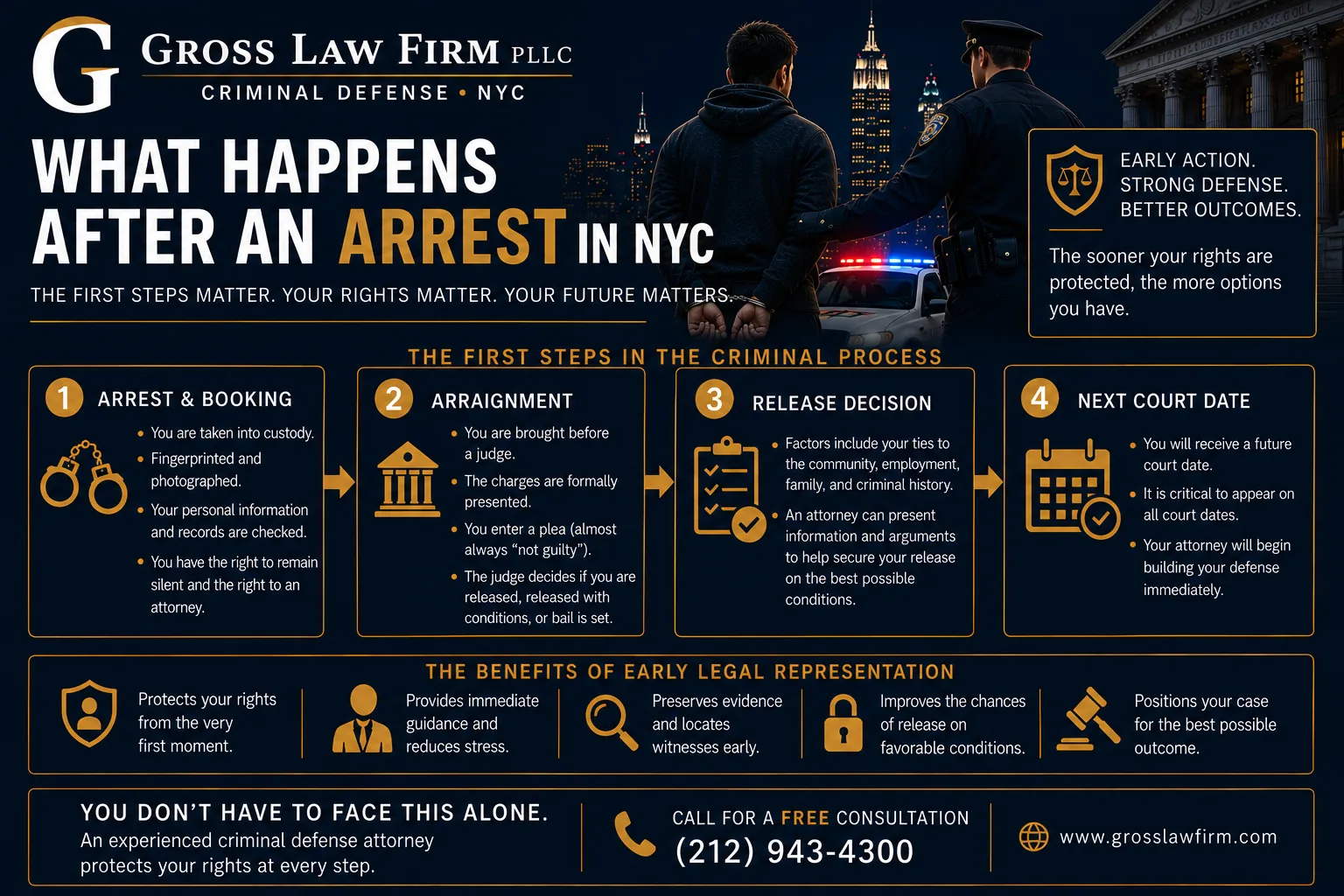
An arrest is one of the most frightening experiences a person can face. Within hours, important decisions may be made that affect your freedom, your employment, your family, and your future. The criminal justice system moves quickly, uses unfamiliar terminology, and can feel overwhelming. This guide explains the process step by step so you know what to expect and how an experienced criminal defense attorney can help at every stage.
Every case is different, and the details below can vary depending on the charges, the borough, and the circumstances of the arrest. The more you understand about the process, the better prepared you will be to protect your rights and make informed decisions during one of the most stressful times in your life.
One theme runs through every stage described below: the earlier an experienced criminal defense attorney is involved, the more options remain open. Bail arguments, evidence preservation, and the tone set with prosecutors from day one are often shaped in the first 24 to 48 hours. Surveillance footage is often automatically deleted within days, witnesses’ memories begin to fade, and opportunities to preserve favorable evidence can quickly disappear.
Step 1: The Arrest and Booking
Once police have probable cause to believe someone committed a crime, an arrest is made. What happens next depends largely on the charge:
- Desk Appearance Ticket (D.A.T.): For many lower-level, non-violent offenses, an eligible person may be fingerprinted and photographed at the precinct, then released with a ticket to appear in court on a future date. Eligibility often depends on the nature of the charge.
- Central Booking: For more serious charges, or if a D.A.T. isn’t available, the person is transported to Central Booking in the relevant borough. This involves fingerprinting, photographing, and a records check, and can take many hours.
A critical point: You have the right to remain silent and the right to an attorney. Anything said to police during this stage can be used later in the case. Politely stating that you want a lawyer and declining to answer further questions is almost always the safest course.
This is also the stage where an experienced attorney can do the most good before ever setting foot in a courtroom. A lawyer who is contacted right after an arrest can reach out to the precinct to invoke your right to remain silent, learn what charges are being considered, and in some cases begin advocating before arraignment even happens. Family members are often unsure who to call or what information matters – an attorney who has handled hundreds of arrests in New York City knows exactly which questions to ask and how to get answers quickly, at a moment when confusion works against you. As a former New York City Public Defender, I have seen firsthand how decisions made during these first few hours can affect the entire course of a case.
Step 2: Arraignment — Your First Court Appearance
In New York City, the law generally requires that a person be brought before a judge for arraignment within 24 hours of arrest (this can stretch somewhat longer around weekends or holidays). For this reason, arraignment courts in NYC run from 9:00 a.m. to 1:00 a.m., including weekends.
At arraignment:
- The prosecution files the formal charging document, your lawyer receives a copy, and you are formally advised in court of the charges against you.
- You enter a plea — almost always “not guilty” at this early stage, even if the case is ultimately resolved differently later. This preserves your rights and gives your defense time to review the evidence and evaluate the strength of the case.
- The judge decides on release conditions: release on your own recognizance, release with conditions (such as check-ins), or bail. New York’s bail laws have been reformed in recent years and now limit cash bail for many non-violent offenses, though judges retain discretion to set bail in more serious or violent felony cases.
This is a brief hearing – often just minutes – but it is one of the most important moments in the entire case. It’s also the point at which your right to counsel formally attaches, meaning you’re entitled to have a lawyer with you for every stage that follows. Having an attorney present and prepared at arraignment can make a real difference in whether you’re released without bail and under what conditions.
Before the arraignment begins, your attorney will usually meet you for the first time in the courthouse holding cells, often through the bars or in a small interview area behind the courtroom. Although the meeting is usually brief because arraignment courts move quickly, it is one of the most important conversations in the case. Your lawyer will explain the charges, identify any immediate legal issues, gather information about your employment, family, medical conditions, and ties to the community, and prepare the strongest possible argument for your release. This is also your opportunity to ask questions, discuss any concerns, and begin working together on your defense from the very first court appearance.
Why does this matter so much? A defense lawyer arriving at arraignment often has only a short window to prepare — sometimes just minutes. A privately retained attorney who already knows the client, has gathered evidence, spoke to family members, understands ties to the community, and has reviewed whatever facts are available going in is in a far stronger position to argue for release on recognizance or favorable bail conditions than one meeting the client for the first time at the courthouse holding cells. The difference between an experienced advocate and an unprepared one at this single hearing can mean the difference between going home that day and spending weeks or months in custody awaiting trial – which is why retaining counsel before arraignment, whenever possible, is so valuable.
Facing arraignment soon? Don’t wait until the courthouse holding cells to get help. Contact Gross Law Firm PLLC now for a free consultation – early involvement can directly affect whether you go home that day.
Step 3: After Arraignment — What Comes Next
Arraignment is the beginning of the case, not the end. Depending on the charge, a few paths open up:
- Misdemeanor cases generally stay in New York City Criminal Court, where the case proceeds through pre-trial hearings, discovery, and potential motions before resolution by plea, dismissal, or trial.
- Felony cases typically require the District Attorney’s office to present evidence to a grand jury, which decides whether there is enough evidence to issue an indictment. If indicted, the case moves to State Supreme Court, where a further arraignment on the indictment takes place.
- Discovery: New York’s discovery laws require prosecutors to turn over evidence to the defense relatively early in the case. This includes police reports, body-worn camera footage, witness statements and information, and other material relevant to your defense. Reviewing this evidence carefully is often where real strategy begins.
- Plea negotiations: Many cases are ultimately resolved through negotiated plea agreements rather than trial. Whether that’s the right path – and on what terms – depends entirely on the facts of your case and the strength of the evidence.
- Hearings and Trial: In some cases, the court will schedule pretrial hearings to determine whether certain evidence, statements, identifications, or other evidence may be used at trial. If the case is not dismissed or resolved through negotiation, it proceeds to trial, where the prosecution must prove every element of the charges beyond a reasonable doubt. An experienced trial attorney will prepare witnesses, cross-examine the prosecution’s witnesses, challenge the admissibility of evidence where appropriate, and present the strongest possible defense on your behalf.
- Adjournment in Contemplation of Dismissal (ACD): In some cases, particularly minor ones, the court may agree to adjourn the case with the understanding that it will be dismissed if certain conditions are met over a period of time.
None of these paths unfold on their own in your favor. Whether discovery is scrutinized closely enough to catch a procedural misstep, whether a plea offer is actually a good deal or one that undersells the weaknesses in the prosecution’s case, whether an ACD or dismissal is even on the table — these outcomes are shaped by the skill and persistence of the attorney handling the case.
An experienced criminal defense lawyer knows the tendencies of the judges and prosecutors in each borough, knows how to press for the strongest possible outcome, and knows when to negotiate versus when to push toward dismissal or trial. Equally important, prosecutors know which attorneys are willing and able to try cases before a jury. A lawyer with substantial courtroom experience and a proven record of successful trial results is often in a stronger position to negotiate because the prosecution understands that an unreasonable offer may result in a trial.
Experience is not simply knowing the law; it is knowing when to negotiate, when to litigate, and when to stand before a jury to protect a client’s rights. That experience also provides clients with confidence that, if a fair resolution cannot be reached, their attorney is fully prepared to take the case to trial. This is where years of practice in the New York City court system translate directly into better outcomes for clients.
What This Means for the Pace of Your Case
Criminal cases in New York City can move slower than people expect, particularly for felony charges, due to court schedules, discovery obligations, and case backlogs. This isn’t unusual, and a longer timeline doesn’t necessarily reflect anything about the strength of your case. It does mean patience is often required, and staying in close communication with your attorney throughout is important.
What You Can Do Right Now
- Do not discuss the facts of your case with anyone other than your attorney – not friends, not family, not on social media, and certainly not with the police.
- Keep records of anything you remember about the arrest – time, location, officers involved, and anything said – while it’s fresh in your mind, and share it with your attorney rather than posting or texting about it.
- Follow all release conditions exactly, including court dates. Missing a court date can result in a warrant for your arrest, even if the underlying case is minor.
- Get an attorney involved as early as possible. The sooner counsel becomes involved, the greater the opportunity to protect your rights, preserve favorable evidence, and influence the direction of the case from the outset.
A Final Word
Being arrested is frightening, and the system is not designed to be easy to navigate on your own. But it is also not a straight line to a bad outcome. At every stage – from the first phone call after an arrest, through arraignment, through discovery and negotiation – an experienced attorney can change what’s possible. That’s the value my office tries to bring to every client: not just knowledge of the process, but the judgment that comes from having guided people through it many times before, at the moments when it counts most.
Nothing in this post is a substitute for individualized legal advice, and reading it doesn’t create an attorney-client relationship – but I hope it gives you a clearer sense of what to expect in the days ahead, and why having the right attorney beside you from the start matters so much.
How Gross Law Firm PLLC Can Help
As a former New York City Public Defender, I have represented thousands of clients facing everything from misdemeanors to the most serious felony charges. I understand how prosecutors build cases, how police investigations work, and how to identify legal issues that others may overlook.
Every case deserves careful preparation, aggressive advocacy, and personalized attention.
If you or someone you love has been arrested anywhere in New York City, do not wait to seek legal advice. The earliest hours after an arrest often have the greatest impact on the outcome of a case. Contact Gross Law Firm PLLC today for a free consultation to discuss your rights and begin building your defense. Early intervention often makes the greatest difference.
Leopold Gross, Esq.
Founder, Gross Law Firm PLLC
Aggressively defending clients throughout New York City.
This article is general information, not legal advice for your situation. Reading it does not create an attorney-client relationship.